How to Follow Up on a Proposal (With 6 Email Templates)
When to follow up after sending a proposal, and six email templates matched to what the client did: never opened it, opened it once, kept returning to the price, or is close to the deadline.
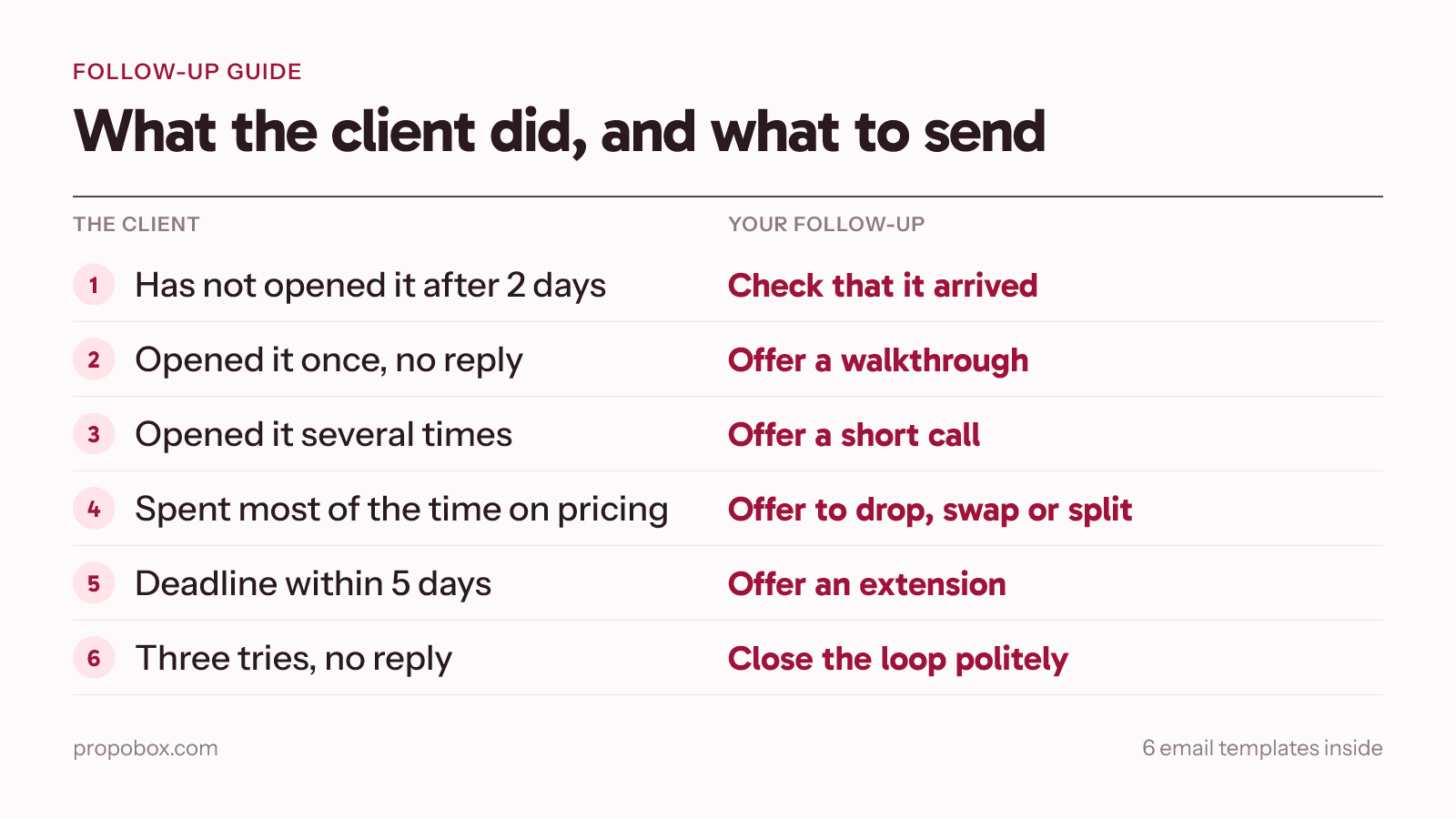
Follow up two business days after sending a proposal if the client has not opened it, and four to five business days after if they opened it and went quiet. If the client named a decision date, use that date instead. Then write to what actually happened, not "just checking in". The six templates below cover the situations you will meet most often.
Guides disagree on the first follow-up, anywhere from two days to a week. The disagreement is a sign that the calendar is the wrong thing to follow. What the client did with the proposal tells you more than how many days have passed.
Match the follow-up to what the client did
These are the six situations a good follow-up tells apart. Each one has a likely reason behind the silence, and the message you send should answer that reason.
1. They have not opened it
When: two business days after sending.
What it usually means: the email is buried, sitting in spam, or went to someone who is not the decision maker. Less often, they are not interested. Either way, the useful message is about delivery, not persuasion.
Hi Dana,
I sent you the proposal for the website rebuild on Tuesday and wanted to make sure it reached you. The link is below whenever you have a moment.
If this is your second attempt, change the channel: a short message on LinkedIn or a call can reach a person your email did not.
2. They opened it once and have not answered
When: four to five business days after sending.
What it usually means: one visit is usually a skim, or someone checking that they received the right file. Silence after one look is not a no.
Hi Dana,
I wanted to check whether the proposal for the website rebuild answered your questions, or whether anything should change. Happy to walk you through it if that helps.
3. They opened it several times
When: within a day of noticing it.
What it usually means: interest and an open question. Reading a proposal again and again without replying often means a decision is being discussed inside their company, or one thing is blocking it.
Hi Dana,
Happy to walk you through the proposal for the website rebuild on a short call and answer any questions on the spot. Would one day this week suit you?
Offer a specific thing, a call, and a time frame. A specific question is easier to answer than an open "any thoughts?".
4. They spent most of their time on pricing
When: within a day of noticing it.
What it usually means: the question is budget, not scope. The best answer offers a way to change the number instead of defending it.
Hi Dana,
One thing I can offer if it helps: if the budget needs to work differently, we can drop or swap an item, or split the payments. Tell me what would fit and I will update the proposal.
Offer to change the scope or the payment schedule before you offer a discount. A lower price for the same work teaches the client that the first price was negotiable.
5. The deadline is close
When: five days or fewer before the proposal expires.
What it usually means: nothing in particular, which is why it needs a message. A date the client can move is better than a deadline that passes in silence.
Hi Dana,
A quick note that the proposal for the website rebuild expires in 3 days. If you need a little more time, tell me and I will extend it.
If they spent their time on a specific part, two short variants fit here as well. For someone who read the terms: "If anything in the terms needs a second look, tell me which part and I will explain it or see what we can change." For someone who read the scope: "If you would like anything added to the scope, or something taken out, tell me and I will adjust the proposal so it matches what you need."
6. Three attempts, no reply: close the loop
When: about three weeks after sending, after the earlier follow-ups.
Hi Dana,
I have not heard back on the website rebuild proposal, so I will assume the timing is not right and close it on my side. If that changes, reply to this email and I will reopen it with current dates and prices. Thank you for considering it.
This message gives the client an easy way to answer, and it keeps your list of open proposals honest.
How often to follow up, and when to stop
- One a day is the ceiling. In practice, one every three or four business days is plenty.
- Three follow-ups over about three weeks, then close the loop. A fourth rarely adds anything the third did not.
- Change something each time. Add a date, an option, an answer to a likely question. A message that repeats the last one gives the client no new reason to reply.
- Use the same thread when you can, so the proposal and the earlier messages are one click away.
Three things not to do
Do not tell them you watched them. "I saw you read the pricing four times" feels like surveillance. Let what you know choose the message, and keep the message about their likely question, as the templates above do.
Do not discount first. If price is the hesitation, offer to change what is included or how it is paid before you change what it costs.
Do not send "just checking in". It asks the client to work out what to say. Every message should carry something they can answer in one line.
Subject lines that work in a busy inbox
- Re: [Project name] proposal
- Question on the [project name] proposal
- [Project name]: expires [date]
- Closing the loop on [project name]
Plain subject lines read like a colleague writing. Anything that sounds like a promotion is easier to ignore.
Let the tool pick the situation
You can run all of this from a spreadsheet. The harder part is noticing which situation a proposal is in on a busy Tuesday.
PropoBox's Follow-ups page applies these rules to the proposals you have sent. It lists the ones nobody has opened two days after sending, the ones within five days of expiring, and the ones read without an answer. For each, it drafts a note and shows you the reason in one line, such as "Dana opened it 3 times and spent most of the time on pricing". The reason is for you only. The note itself never mentions visits, reading time or sections. You edit it freely, and it is sent exactly as you wrote it, with one nudge per proposal per day at most. See how proposal tracking works, or read more on what to watch and what to ignore.
Whichever tool you use, the habit matters more than the software. Check once a day, find the proposals that changed, and write to what happened.
Related reading
Frequently asked questions
How long should I wait before following up on a proposal?
If the client gave you a decision date, follow up on that date. Otherwise, two business days after sending if they have not opened it, and four to five business days if they opened it and have not replied. Waiting less than two days can read as pressure, and waiting more than a week lets the proposal go cold.
How many times should I follow up on a proposal?
Three follow-ups over about three weeks is a sensible limit, with the third one closing the loop politely. Change something each time, such as a date, an option or an answer to a likely question.
Should I follow up on a proposal by email, phone or message?
Start with email in the same thread. If the first follow-up gets no reply, change the channel for the second: a short call or a message on the platform where you already talk. Keep the written record in email.
What should I say if the client asks for more time to think?
Ask when they expect to decide and what would help them get there, then write the date down and follow up on it. Offer one useful thing, such as a short call to answer questions, a revised option, or an extension of the proposal's validity date.
Newer
Proposal Tracking Best Practices: What to Watch and What to Ignore
Older
How to Turn Discovery Notes Into a Client Proposal
Start from a finished template
Real line items, prices and terms you replace with your own.
Related articles
Ready to create better proposals?
Start free, no credit card required.