Proposal Tracking Best Practices: What to Watch and What to Ignore
What proposal tracking can and cannot tell you, the three levels of data worth watching, and how to turn each reading pattern into a follow-up without making the client feel watched.
Track three things: whether the proposal was opened, how many times and for how long, and which section was read. Use them to decide who to contact today and what to say. Ignore opens that happen within seconds of sending, treat a visit count without reading time as weak evidence, and never quote the data back to the client.
That is the short version. The rest of this guide explains why, what each pattern usually means, and how to build a daily habit around it.
Why a plain "opened" notification misleads
Most email tracking works through a tiny image that loads when the message is displayed. Some mail apps and security scanners load that image automatically, so an "open" can be recorded when nobody has read anything. A proposal sent as a PDF attachment cannot be tracked at all.
Tracking that lives on the proposal page itself is closer to reading. It knows that a person had the page open and for how long, rather than that an email was delivered. It still needs filtering: your own previews, your team's visits and link scanners should be left out, or the numbers describe you rather than your client.
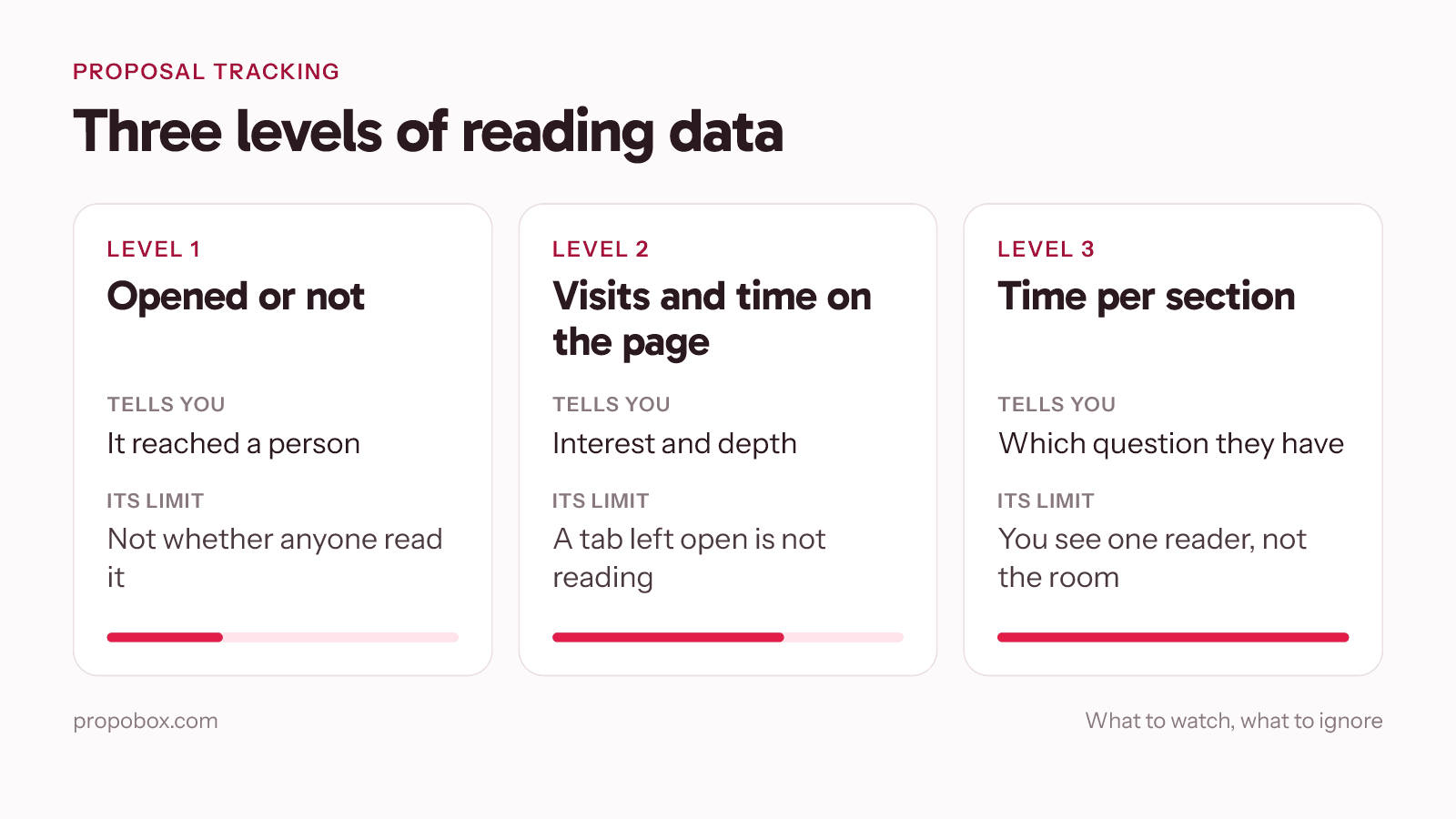
The three levels of tracking data
Level 1: opened or not
Tells you: the proposal reached a person, if previews and scanners are excluded.
Does not tell you: whether anyone read it. Use it to find delivery problems, not interest.
Level 2: visits and time on the page
Tells you: interest and depth. Two visits of three minutes each says more than one visit of ten seconds.
Limit: time counts while the page is visible, but a tab left open is not reading. Treat time as a range, not a measurement.
Level 3: time per section
Tells you: which question the client has. Time on pricing points to budget, on the terms to risk, on the scope to fit, on the timeline to a date that matters.
Limit: you see one reader. A proposal forwarded to a colleague is read somewhere you cannot see, and several people opening the same link look like one person with many visits.
What each pattern usually means
These are patterns, not facts. They suggest what to say. They do not prove what the client intends.
- Never opened after two business days. Likely a delivery problem. Resend, or reach the person another way.
- One short visit, no reply. Likely a skim. Wait a few days, then offer a short walkthrough.
- Several visits, most of the time on pricing. Likely a budget question. Offer to drop or swap an item, or to split the payments.
- Terms read first. Probably someone from legal or finance is involved. Offer to explain or adjust the terms.
- Time on scope and deliverables. The client is checking fit. Offer to add or remove something.
- Opened again after days of quiet. The conversation restarted on their side. Be easy to reach and do not pile on messages.
For the wording that goes with each of these, see how to follow up on a proposal, which has a template for every situation above.
Build a daily habit, not a dashboard habit
The common failure is checking tracking constantly and acting on none of it. A better routine is once a day, three lists:
- Sent but unopened after two business days.
- Expiring within five days.
- Reopened or read since your last look.
Act on those, and ignore the rest. A proposal that was opened an hour ago and has no reply yet needs nothing from you.
Numbers worth keeping across your proposals
Per-proposal data helps you follow up. Account-level numbers help you improve how you sell. Keep a simple record of:
- time from sending to the first open
- the share of proposals opened within two business days
- the share signed within your usual decision window
- how many received a follow-up, and how many of those replied
Write down a baseline for a month before you change anything, so you can tell whether a change helped. Small samples move around a lot, so look at trends over weeks rather than single proposals.
Be careful with what you tell the client
Do not say "I saw you read the pricing four times". Do not mention the time of day they opened it. Let what you know shape the message and keep the message about their likely question, not about their behavior.
Tracking also has a privacy side. Mention it in your own privacy notice, and check the rules that apply where your clients live.
Where PropoBox fits
PropoBox records each visit and how long the proposal page was actually open and visible. Visits from you, your team, bots and email link scanners are left out. Visits, reading time, notifications, the follow-up list, email opens and bounces are on every plan, including Free. Pro and Business add the time spent on each section and clicks on the email link.
The home screen then lists the proposals that need you: read without an answer, not opened two days after sending, expiring within five days, or signed with the deposit still waiting. Each has a suggested note, and the reason is shown to you only. See proposal tracking and proposal analytics, or start by sending your first proposal on the Free plan.
Related reading
Frequently asked questions
What is proposal tracking?
Proposal tracking shows what happens to a proposal after you send it: whether the client opened it, how many times, for how long and, in some tools, which sections they read. It lets you decide who to contact and what to say, instead of following up on a fixed schedule.
How accurate is open tracking?
Email open tracking can overcount, because some mail apps and scanners load tracking images automatically. Tracking on the proposal page is more reliable, especially when it leaves out your own visits and known bots. Treat any single number as a hint and look at patterns across visits.
What should I do when a client opens a proposal many times?
Many visits with no reply usually mean interest and an open question. Do not mention that you saw the visits. Send a short note that offers something specific, such as a walkthrough call, a change to the scope, or a different payment split, depending on which section they spent the most time on.
Is it acceptable to track whether clients read proposals?
It is common practice, and it is reasonable if you use it to be more helpful rather than more pushy. Mention it in your privacy notice and check the rules where your clients live. Do not quote the data back to the client.
Newer
Proposal Software Pricing in 2026: What a 3-Person Agency Pays
Older
How to Follow Up on a Proposal (With 6 Email Templates)
Start from a finished template
Real line items, prices and terms you replace with your own.
Related articles
Ready to create better proposals?
Start free, no credit card required.