
How to Write a Proposal Scope of Work Clients Can Understand
A scope of work is the part of a proposal a client can check later. How to write deliverables, exclusions, client duties and a change path that hold up, with examples and a fill-in outline.
A client can agree with the goal of a project and still be buying something different from what you plan to deliver. They picture a bigger deliverable, count on more review rounds, or assume a task is yours when you assumed it was theirs. The scope of work is the part of the proposal that closes that gap before anyone signs.
To write a proposal scope of work, state the purpose in one sentence, list deliverables the client can check, name what is not included, say what you need from the client and by when, set the review rules, and describe how a new request gets handled. Each line should be specific enough to point at and short enough to read on a phone.
What a scope of work is, and what it is not
In a proposal, the scope of work says what you will do, what the client receives and where the engagement stops. It is not the whole contract. Asana describes a scope of work as defining "the specific tasks, deliverables, and timeline for a project", and a statement of work as "a comprehensive agreement that includes the scope of work", with legal terms and payment added on top (Asana, published August 21, 2026). Write the scope for the client who is deciding whether to say yes. Leave the legal wording to your contract, and to a lawyer if the stakes call for one.
Start with the purpose and where it stops
Write two or three sentences before any list: the situation, the result the client wants, and the line between this project and the next one.
This project defines the audience and core message for a growing consultancy and produces a messaging brief for the website. Website design, development and campaign work are separate and not part of this phase.
The last sentence earns its place. It names the adjacent work a client is most likely to assume is included.
Write deliverables the client can check
A task describes your effort. A deliverable is something the client can receive, open and approve. "Research competitors" is a task. "A summary of five agreed competitors, in one shared document" is a deliverable.
For each deliverable, give five facts:
- the name of what they receive
- the format: a document, a call, a set of files, a live page
- how many and how big: eight sections, six pages, two calls
- what is inside it and what is not
- when it arrives
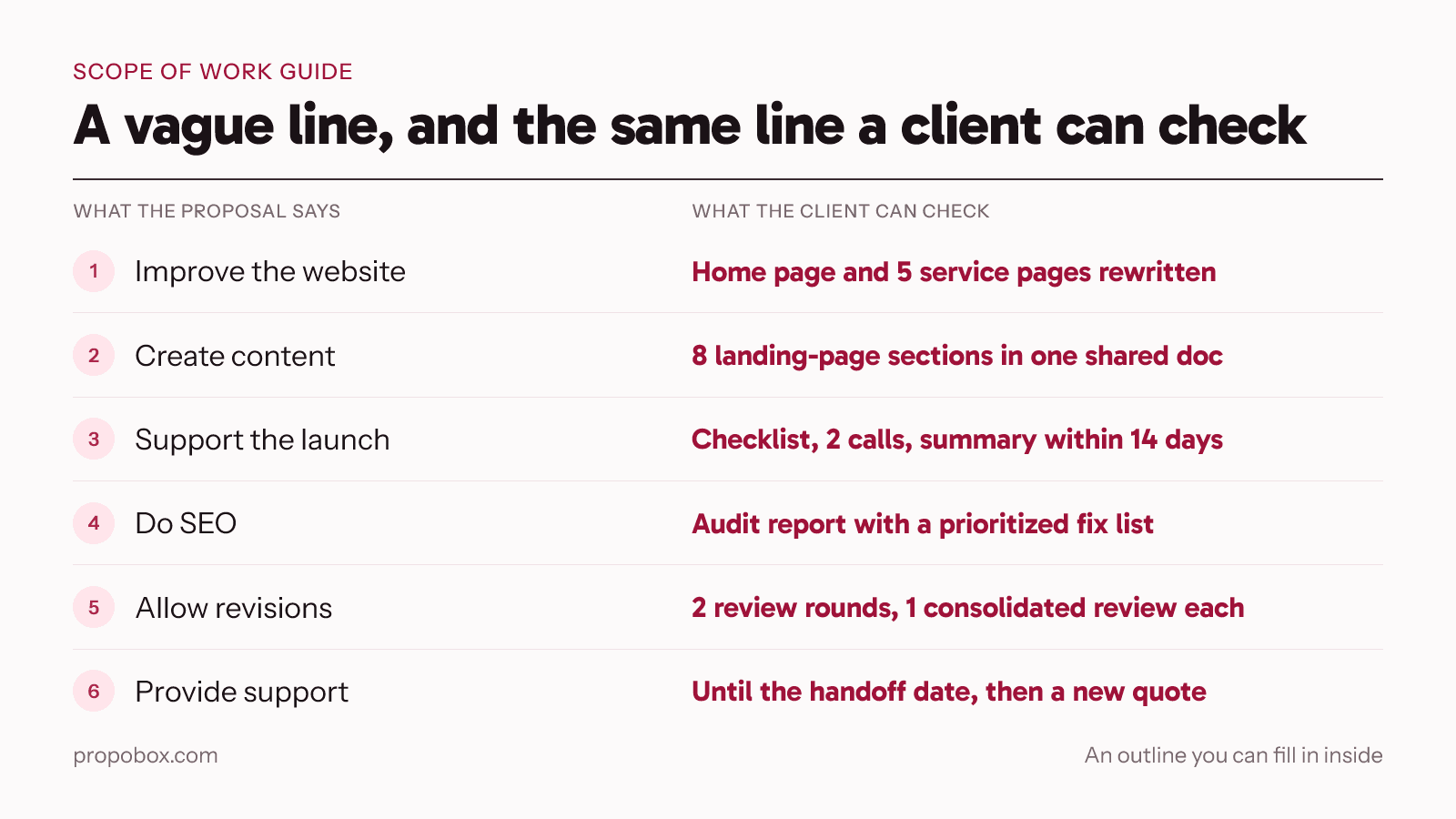
Here is how vague lines turn into lines a client can check:
- "Improve the website" becomes "Rewrite of the home page and five service pages, delivered in one shared document, with two review rounds."
- "Create content" becomes "Eight landing-page sections based on the agreed brief."
- "Support the launch" becomes "A launch checklist, two review calls and a written summary within 14 days of launch."
- "Do SEO" becomes "An audit report with a prioritized fix list and one walkthrough call."
Add the detail that changes what the client expects to receive. Skip the rest. A long scope that nobody finishes reading protects no one.
Break long work into phases
Three or four phases are easier to review than twenty-five tasks. Give each phase one thing the client has to do before the next one begins, such as approving a brief or sending files. If a phase waits on the client, write that down. A timeline that depends on their feedback is not unconditional, and the proposal should not imply it is.
Name what is not included
Exclusions are the most skipped part of a scope and one of the most useful. Clients tend to assume that anything adjacent is included until they are told otherwise. Pick the requests you actually get and write them down:
- copywriting beyond the pages listed
- revisions beyond the rounds in the scope
- stock images, fonts, paid tools and other third-party costs
- setup or configuration on the client's side
- support after the handoff date
Avoid "anything else" as an exclusion. It reads like a trap and nobody can check it. A specific list is easier to accept, and easier to point to when a request arrives. In our own web design proposal template, copywriting is left out on purpose and the page count is capped at eight, so a ninth page becomes a new quote instead of an argument.
Put the client's work in the scope
Many scope problems are ownership problems. Say who provides the content, who gives access, who collects feedback inside the client's team, and how many days they have to respond. One named decision owner on the client side prevents most of the contradictory feedback that stretches a project.
Write each of these as a condition on the date: "The launch date assumes the final copy arrives by 3 December." If the input is late, the date moves, and the client already agreed to that.
Set review rules and say what done means
Acceptance does not need to be technical. It needs to say what the client reviews, who can approve it, how many rounds are included, how feedback should arrive and how long the client has to respond. Tie "done" to the agreed brief and the listed deliverables. "The client is satisfied" alone is too open to settle anything.
The messaging brief is complete when it covers the agreed audience, positioning questions and page priorities and is delivered as a shared document. The client sends one consolidated review within five business days. A request that adds a new audience or page set is handled as a change before work on it starts.
Decide how changes are handled
A change path can be five steps:
- The request is written down.
- You check it against the approved scope.
- If it sits outside, you tell the client what it does to the schedule and the price.
- The client approves, declines or postpones it.
- Work on it starts only after that answer.
Put this in the proposal before the first extra request arrives. Sent afterwards, in an email, the same five steps sound like a reaction to that request.
A scope outline you can fill in
Use these eight headings and keep each to a few lines:
- Purpose and boundary
- Deliverables
- Phases and timing
- What the client provides
- Assumptions
- Not included
- Review and acceptance
- How changes are handled
Then read it the way the client will. Could someone new to the project say what they are approving without asking you what a term means?
How the scope is set up in PropoBox
We build PropoBox, so this is the part we can describe from the inside. On the paid plans, Advanced mode gives the scope its own structure:
- a scope block with a summary, a total duration, and two lists: Included and Not included
- a timeline of phases, each with a name, description, duration and dates
- deliverables, each with a name, format, description, delivery time and quantity
- optional blocks for Scope protection, Client responsibilities and Revisions and approvals, which carry wording you write yourself. PropoBox does not write contract terms for you.
The Free plan uses Quick mode, so there the scope lives in the line item descriptions and the terms.
The part that matters in a scope dispute comes at signing. When the client accepts, the scope, timeline, deliverables, payment and those optional blocks are saved as they stood and covered by the signature record's SHA-256 fingerprint, so the signed copy shows what the client saw. If you edit the proposal after the client has opened it, their signature is refused with a message to review the update first, so nobody signs a version you have already changed. Client approval and e-signature describe the rest of that flow. This is a record of what was shown and accepted. Whether it is enough for your contract is a question for your lawyer.
Mistakes to avoid
- Broad labels such as "strategy", "support" and "optimization" with no output attached.
- A timeline that lists only your tasks and leaves out the client's reviews and inputs.
- A delivery date with no stated dependencies.
- Exclusions added as an afterthought, or written as "anything else".
- Acceptance defined as the client being happy.
- A scope so long that nobody reads it. Tables and short sentences help, and contract detail belongs in the contract.
If you would rather edit a scope than write one, start from the web design proposal template. It splits a six-week project into four stages, caps the page count and leaves copywriting out, so you can see exclusions inside a working proposal and change the numbers to fit your own work.
Frequently asked questions
What should a scope of work include in a proposal?
The purpose, the deliverables, phases and timing, what the client provides, assumptions, what is not included, the review and acceptance rules, and how changes are handled.
Is a scope of work the same as a statement of work?
Usually not. Asana describes a scope of work as defining the tasks, deliverables and timeline, and a statement of work as a fuller agreement that includes the scope plus items such as legal terms and payment. Which one you need depends on the project and your contract.
How detailed should a scope of work be?
Detailed enough that the client can say what they will receive, what they must provide and when, without asking you to translate. Cut anything that does not change those answers.
Should a proposal list what is not included?
Yes. Name the adjacent work clients most often assume is included, such as extra revisions, copywriting, third-party costs and support after handoff. A specific list works better than a catch-all line.
How do I prevent scope creep with a proposal?
Write deliverables the client can check, list the exclusions, set the number of review rounds, and explain in the proposal how a new request is assessed before any work on it begins.
Can AI write a scope of work?
It can organize notes from a discovery call into a first draft. You still need to check every deliverable, exclusion, date and client duty against what was agreed, because generated text can add commitments nobody made.
Start from a finished template
Real line items, prices and terms you replace with your own.
Related articles
Ready to create better proposals?
Start free, no credit card required.